
Planetary boundaries: Why sustainability cannot be ignored
Before exploring sustainability further, it is important to understand why it is a critical issue and why achieving it is necessary. Life on Earth depends on finite resources, and exceeding these limits threatens the planet's stability. One useful way to approach sustainability and understand its importance is through the planetary boundaries framework. They describe the environmental limits within which human activity can remain safe without weakening the planet’s long-term resilience. The boundaries offer a scientific basis for understanding the conditions needed to keep the planet stable and habitable.
Developed in 2009 and later updated by a team of researchers led by Johan Rockström, the planetary boundary framework identifies nine critical Earth system processes that regulate the stability of the planet. If these limits are exceeded, the risk of triggering massive, sudden or irreversible environmental changes that could make the planet less suitable for human societies increases.
Sustainability is fundamentally about maintaining the conditions necessary for human and ecological well-being over the long term. Planetary boundaries provide a scientific basis for sustainability by setting clear limits on human activity. Staying within these limits allows society and technology to develop without jeopardizing the stability of Earth's systems.
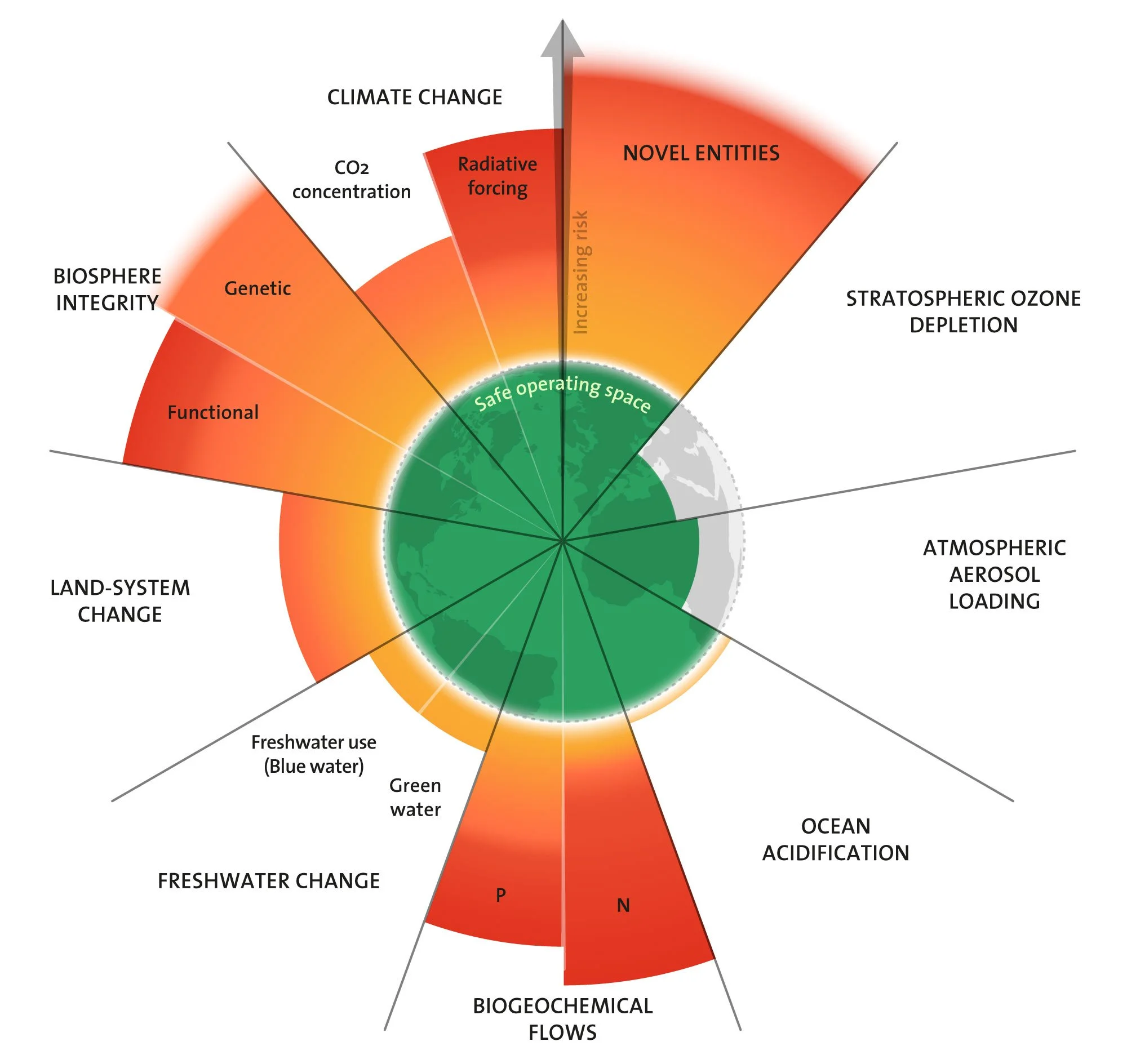
Nine planetary boundaries and their current state. Green areas represent the “safe operating space” where human activities remain within sustainable limits. Orange and red areas show boundaries that have been significantly crossed, suggesting a high risk of destabilizing ecosystems, climate systems, and essential Earth processes. Image from: Stockholm Resilience Centre, based on analysis in Sakschewski and Caesar et al. 2025.
Planetary boundaries and environmental risks
Exceeding the boundaries can lead to environmental degradation, resource scarcity, and climate disruptions that threaten economic and social stability. For example, crossing the climate change boundary increases the frequency and intensity of extreme weather events and accelerates sea level rise, with impacts on areas such as food production and water availability. Similarly, biodiversity loss weakens ecosystems, making them less resilient to changes, while excessive nitrogen and phosphorus use leads to water pollution and ocean dead zones. As these limits are interconnected, crossing one increases the risk of crossing others, threatening the goal of sustainability.
A closer look at the planetary boundaries shows which parts of Earth’s systems are under pressure from human activity. Each boundary represents a process that keeps the planet stable, and several have already moved beyond the safe range. The following sections identify these boundaries, explain their roles, and describe the risks associated with ongoing disruption.
Climate change: This boundary concerns Earth’s energy balance, which is heavily influenced by greenhouse gases, such as CO₂. These gases trap heat in the atmosphere, leading to a rise in global temperatures. Warming disrupts weather patterns, increases the frequency and intensity of extreme events, accelerates ice melting in polar regions, and contributes to rising sea levels. Crossing this boundary threatens ecosystems and the stability of the global climate system.
Biosphere integrity: It reflects the overall health and resilience of ecosystems, as well as the diversity of species and genetic variation. Human pressures, including habitat loss and the overuse of natural resources, are causing biodiversity to decline at exceptional rates. Ecosystem degradation affects essential functions such as nutrient cycling, carbon storage, and natural regulation of climate, which in turn affects the stability of other planetary systems.
Biogeochemical flows (nitrogen and phosphorus cycles): This boundary tracks the natural cycles of nitrogen and phosphorus, which support ecosystem productivity. Human activities like fertilizer use and industrial emissions have disrupted these cycles, causing nutrient pollution, dead zones in water bodies, and damage to ecosystems. Current levels of nitrogen fixation already exceed the planet’s natural limits.
Land-system change: Large-scale deforestation and the conversion of land for agriculture and urban development have major impacts on ecosystems, carbon storage, and water cycles. Forests and natural landscapes have important roles, for example in regulating climate and supporting biodiversity. Losing planet’s original forests has among other things disrupted local weather patterns and reduced habitats for countless species.
Freshwater use: Human activities are increasingly affecting the global water cycle, altering the availability of water in rivers, lakes, groundwater, and soil. Overuse, pollution, and diversion of freshwater resources lead to droughts and degraded ecosystems. These changes lead to threatened agriculture and reduce drinking water supplies.
Novel entities (chemical pollution): Human-made substances, including chemicals, plastics, and heavy metals, are accumulating in the environment. Many of these substances have not been tested for long-term ecological or health effects, yet they are spreading through soil, water, and air. Their presence disrupts ecosystems and harms wildlife, and can enter food chains, with some already exceeding safe levels.
Ocean acidification: Oceans absorb a large portion of human-emitted CO₂, which lowers water pH and alters chemical balances. This acidification particularly affects marine organisms that rely on calcium carbonate, such as corals and shellfish, making it more difficult for them to grow and survive. As acidification intensifies, it disrupts food webs and weakens reef ecosystems.
Stratospheric ozone depletion: The ozone layer acts as a shield, protecting life on Earth from harmful ultraviolet (UV) radiation. Human-made chemicals such as chlorofluorocarbons (CFCs) have damaged the layer, increasing the risk to ecosystems. International agreements like the Montreal Protocol have led to significant recovery, but the ozone layer remains vulnerable, and continuous monitoring and regulation are necessary to ensure it returns to safe levels and continues to protect the planet.
Atmospheric aerosol loading: Aerosols come from both human activities and natural sources. These particles influence climate by reflecting or absorbing sunlight and affecting cloud formation. They also pose risks to human health, contributing to respiratory and cardiovascular problems. While global aerosol levels have been decreasing in some regions due to cleaner technologies and regulations, high concentrations persist locally, continuing to impact both the environment and public health.
Challenges and pathways to sustainability
Achieving sustainability within the planet’s limits can be challenging because the economy relies on resource-intensive industries, environmental governance is weak, technological barriers persist, and society is resistant to change. Economies often prioritize short-term growth over environmental protection, and international policies are frequently insufficient. Transitioning to sustainable technologies requires significant investment and infrastructure changes, which take time to implement. In addition, high levels of consumption and inequality make reducing environmental impacts difficult, with the most vulnerable communities facing the most severe consequences. Overcoming these challenges requires global cooperation and policies that balance development with environmental stability.
To stay within the limits of the planet, the economy must move away from endless growth and resource consumption. A circular economy, where materials are reused and waste is minimized, reduces pressure on natural resources. Investing in renewable energy sources such as solar and wind energy is essential to reduce emissions and slow climate change. Governments and businesses should support green technologies and implement stronger environmental policies. By, for example, taxing pollution, limiting deforestation, and promoting sustainable agriculture, economic growth can be managed within safe limits.
Additionally, individuals play a crucial role in shaping the economy by encouraging responsible consumption and choosing sustainable products. Education and awareness are essential for promoting choices that contribute to long-term sustainability. Balancing the economy with the limits of our planet requires governments, businesses, and individuals to work together. By rethinking resource use and shifting investment to sustainable development, it is possible to build an economy that supports both human well-being and a stable planet.
In conclusion, sustainability is essential because Earth’s resources are finite, and exceeding environmental limits through excessive consumption and emissions threatens planetary stability. The planetary boundaries framework identifies nine critical Earth system processes that must be maintained to avoid irreversible environmental damage. Achieving sustainability is challenging due to economic reliance on resource-intensive industries and weak governance. Staying within planetary boundaries requires changes in consumption and production patterns, including a shift toward a circular economy and the implementation of stronger policy frameworks.
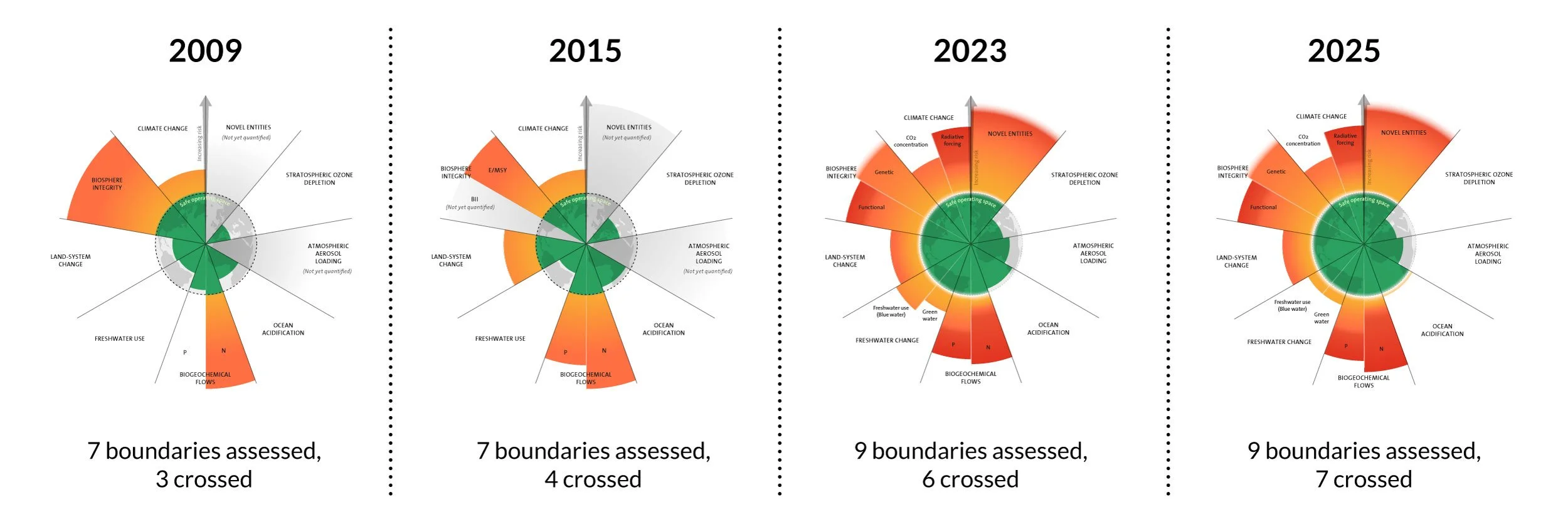
The worsening state of planetary boundaries (2009–2025). Over time, human activity has pushed Earth well beyond its safe environmental limits. In 2009, three of the nine planetary boundaries had been breached. By 2015, that number had risen to four, and as of 2023, six boundaries were exceeded. In 2025, seven boundaries are crossed. Image from: Stockholm Resilience Centre, Stockholm University. Based on Sakschewski and Caesar et al. 2025, Richardson et al. 2023, Steffen et al. 2015, and Rockström et al. 2009.
References:
Rockström, J., Steffen, W., Noone, K., Persson, Å., Chapin, F. S., Lambin, E. F., Lenton, T. M., Scheffer, M., Folke, C., Schellnhuber, H. J., Nykvist, B., De Wit, C. A., Hughes, T., Van Der Leeuw, S., Rodhe, H., Sörlin, S., Snyder, P. K., Costanza, R., Svedin, U., . . . Foley, J. A. (2009). A safe operating space for humanity. Nature, 461(7263), 472–475. https://doi.org/10.1038/461472a
Richardson, K., Steffen, W., Lucht, W., Bendtsen, J., Cornell, S. E., Donges, J. F., Drüke, M., Fetzer, I., Bala, G., Von Bloh, W., Feulner, G., Fiedler, S., Gerten, D., Gleeson, T., Hofmann, M., Huiskamp, W., Kummu, M., Mohan, C., Nogués-Bravo, D., . . . Rockström, J. (2023). Earth beyond six of nine planetary boundaries. Science Advances, 9(37). https://doi.org/10.1126/sciadv.adh2458
Rockström, J., Steffen, W., Noone, K., Persson, Å., Chapin, F. S. I., Lambin, E., Lenton, T. M., Scheffer, M., Folke, C., Schellnhuber, H. J., Nykvist, B., De Wit, C. A., Hughes, T., Van Der Leeuw, S., Rodhe, H., Sörlin, S., Snyder, P. K., Costanza, R., Svedin, U., . . . Foley, J. (2009). Planetary Boundaries: Exploring the safe operating space for humanity. Ecology and Society, 14(2). https://doi.org/10.5751/es-03180-140232
O’Neill, D. W., Fanning, A. L., Lamb, W. F., & Steinberger, J. K. (2018). A good life for all within planetary boundaries. Nature Sustainability, 1(2), 88–95. https://doi.org/10.1038/s41893-018-0021-4
Sakschewski, B., Caesar, L., Andersen, L., Bechthold, M., Bergfeld, L., Beusen, A., Billing, M., Bodirsky, B. L., Botsyun, S., Dennis, D. P., Donges, J., Dou, X., Eriksson, A., Fetzer, I., Gerten, D., Häyhä, T., Hebden, S., Heckmann, T., Heilemann, A., . . . Rockström, J. (2025). Planetary Health Check 2025. In PIKpublic. https://doi.org/10.48485/pik.2025.017
Steffen, W., Richardson, K., Rockström, J., Cornell, S. E., Fetzer, I., Bennett, E. M., Biggs, R., Carpenter, S. R., De Vries, W., De Wit, C. A., Folke, C., Gerten, D., Heinke, J., Mace, G. M., Persson, L. M., Ramanathan, V., Reyers, B., & Sörlin, S. (2015). Planetary boundaries: Guiding human development on a changing planet. Science, 347(6223). https://doi.org/10.1126/science.1259855
Caesar, L., Sakschewski, B., Andersen, L. S., Beringer, T., Braun, J., Dennis, D., Gerten, D., Heilemann, A., Kaiser, J., Kitzmann, N.H., Loriani, S., Lucht, W., Ludescher, J., Martin, M., Mathesius, S., Paolucci, A., te Wierik, S., & Rockström, J. (2024). Planetary Health Check Report 2024. Potsdam Institute for Climate Impact Research, Potsdam, Germany. (*equal contributors to this work and designated as co-first authors)
Planetary boundaries. (n.d.). Stockholm Resilience Centre. https://www.stockholmresilience.org/research/planetary-boundaries.html
