
The three dimensions of sustainability
To understand sustainability, we need to look at the factors that influence it. Sustainability is commonly linked to nature and climate, mainly because environmental protection is the most visible part of the conversation. However, sustainability has a broader meaning. It describes how society works as a whole and how human activity connects with the world around us. To explain this idea, sustainability is described through environmental, social, and economic dimensions, which are closely connected and support each other. Economic activity needs to stay within natural limits and improve quality of life. Social actions should promote fairness without harming nature. Environmental protection must also consider people’s needs and economic factors. Sustainability can only be achieved when these three areas support one another.
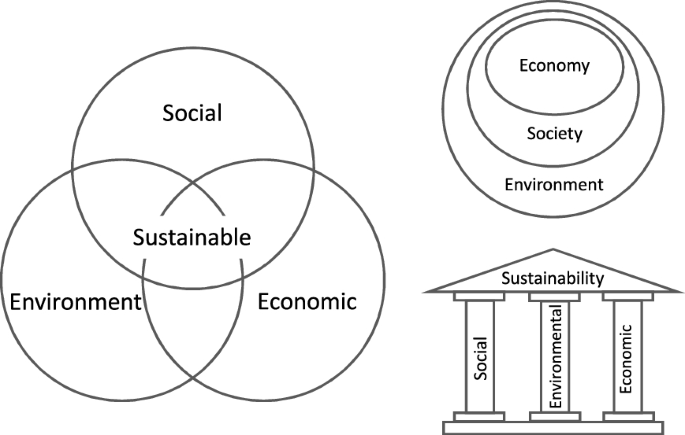
Different ways to represent sustainability. The most typical representation is three intersecting circles. Sustainability is also represented as three pillars or concentric circles. Image from: Purvis, Mao & Robinson (2019).
Ecological sustainability is about keeping natural systems healthy so they can support life in the long term. It involves using resources at a rate that allows nature to recover, while limiting pollution, reducing waste, and protecting ecosystems and biodiversity. Healthy ecosystems provide clean air, safe water, fertile soil, and a stable climate. All of these affect human health and economic activity. When natural systems are damaged, the effects often last for decades and are difficult to fix. Ecological sustainability therefore focuses on prevention and keeping human activity within the planet’s limits.
Social sustainability brings the focus to people and communities. In businesses, this includes fair treatment at work, safe and healthy conditions, reasonable working hours, and respect for labor rights. It also covers equal opportunities, diversity, access to training, and protection from discrimination. Beyond the workplace, it involves responsible sourcing, involvement in local communities, and respect for human rights across the supply chain. Companies that ignore these issues often lose trust from employees and customers. When people feel respected and fairly treated, organizations tend to be stronger.
Economic sustainability looks at how economic value is created and sustained over time. It is not only about profit, but about the way that profit is created. Businesses need to consider social and environmental effects when making decisions and managing risks. This helps support long-term growth without damaging people or natural systems.
A simple example is a basic cotton T-shirt. Its sustainability is not only about how much water or energy is used to produce it. Social questions matter too. Who made the shirt? Were the working conditions safe? Were workers paid fairly? The economic side also plays a role. Is the price realistic enough to support fair salary and responsible production? If any of these aspects are ignored, the product cannot be considered truly sustainable.
Many organizations use ESG (environmental, social, and governance) reporting to show how they perform in these areas. In Europe, ESG reporting is largely mandatory due to EU sustainability reporting rules. ESG reporting provides clear and detailed information that helps investors, regulators, customers, and employees understand how a company is functioning. Frameworks such as the Global Reporting Initiative (GRI) support consistent measurement and make results more comparable across companies. Reporting improves accountability and helps sustainability considerations become part of regular business decisions.
The main idea is that sustainability is not a single concept, but a whole system made up of interconnected dimensions. Economic growth that ignores environmental limits leads to resource loss and climate risks. Environmental actions that overlook social fairness can increase inequality. Progress in one area often depends on progress in the others. Viewing sustainability as a connected system helps communities make better decisions that support people, protect nature, and build stable economies.
References:
Purvis, B., Mao, Y., & Robinson, D. (2019). Three pillars of sustainability: in search of conceptual origins. Sustainability Science, 14(3), 681–695. https://doi.org/10.1007/s11625-018-0627-5
Hansmann, R., Mieg, H. A., & Frischknecht, P. (2012). Principal sustainability components: empirical analysis of synergies between the three pillars of sustainability. International Journal of Sustainable Development & World Ecology, 19(5), 451–459. https://doi.org/10.1080/13504509.2012.696220
Khamisu, M. S., & Paluri, R. A. (2024). Emerging trends of environmental social and governance (ESG) disclosure research. Cleaner Production Letters, 7, 100079. https://doi.org/10.1016/j.clpl.2024.100079
Bosi, M. K., Lajuni, N., Wellfren, A. C., & Lim, T. S. (2022). Sustainability Reporting through Environmental, Social, and Governance: A Bibliometric Review. Sustainability, 14(19), 12071. https://doi.org/10.3390/su141912071
UN Global Compact. (n.d.). Social sustainability. UN Global Compact. https://unglobalcompact.org/what-is-gc/our-work/social
Wang, K., & Ke, Y. (2024). Social sustainability of communities: A systematic literature review. Sustainable Production and Consumption, 47, 585–597. https://doi.org/10.1016/j.spc.2024.04.031
Da Cunha, Í. G. F., Policarpo, R. V. S., De Oliveira, P. C. S., Abdala, E. C., & Rebelatto, D. a. D. N. (2025). A systematic review of ESG indicators and corporate performance: proposal for a conceptual framework. Future Business Journal, 11(1). https://doi.org/10.1186/s43093-025-00539-1
Byrne, D. (2025, November 28). ESG: A comprehensive guide to the main principles. The Corporate Governance Institute. https://www.thecorporategovernanceinstitute.com/insights/guides/esg-a-comprehensive-guide-to-environmental-social-and-governance-principles/?srsltid=AfmBOoqThSxV7D8C20dEOaJxHq4oXsrk3DK488ahRhrWJ2Bm48n94fFi
