
The climate impact of food choices
Food has a large effect on the climate. When we count farming, land use, processing, and transport, the food system is responsible for about one quarter of global greenhouse gas emissions. This makes what we eat one of the most important daily factors influencing our personal carbon footprint. A common recommendation is to “eat local” to reduce emissions. Local food can have benefits but when it comes to climate impact, this advice only captures a small part of the picture. Most emissions from food do not come from transport. They come from how food is produced.
Where food emissions actually come from
Food goes through many steps before it reaches the consumer. It is grown or raised, often with fertilizers or animal feed, then processed, stored, and transported. Each step produces emissions, but the largest share comes from production itself, not transport. In most cases, transport is less than 10% of total emissions, and for some foods like beef it can be below 1%.
The type of food matters much more than distance. Animal-based products, especially beef and lamb, have high emissions because they need large areas of land, large amounts of feed, and they produce methane during digestion. Producing 1 kg of beef creates around 60 kg of greenhouse gases, while 1 kg of peas produces about 1 kg. This difference is so large that transport distance has only a small effect in comparison. The following chart shows that most emissions come from production and land use, not transport.
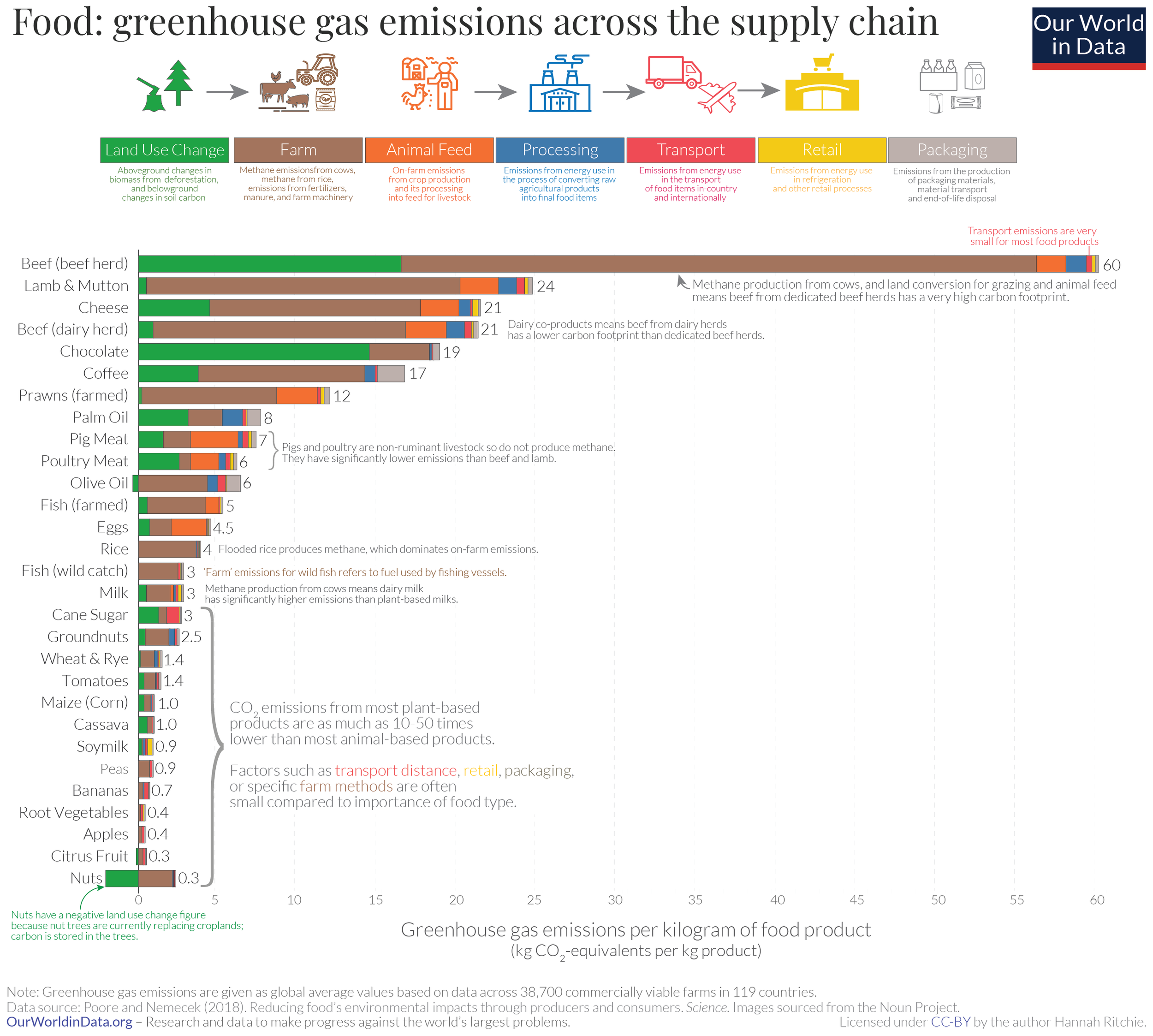
Greenhouse gas emissions across the food supply chain. Most emissions come from production and land use, while transport plays a much smaller role. Source: Our World in Data https://ourworldindata.org/food-choice-vs-eating-local
Food transport is often assumed to be a major source of emissions. International trade is mainly done by ship, which has relatively low emissions per kilogram of food. For example, shipping avocados from Mexico to the United Kingdom adds about 0.21 kg of CO₂-equivalent per kilogram of food. This is only a small part of their total climate impact and still much lower than the emissions from many locally produced animal products.
Air transport is different. It has very high emissions but is used only for a small share of food. It is mostly used for fresh and expensive products that spoil quickly, such as berries, asparagus, or green beans when they are out of season. Because air freight is rarely labeled, it is difficult for consumers to identify these products. In general, foods that are very fresh, seasonal, and available far from where they are grown, are more likely to be transported by plane.
What the evidence says
Many studies comparing food systems in different countries show the same result. The main factor behind dietary emissions is not trade or transport, but what people eat. Even when researchers include emissions from imported food and land use changes in other countries, diets with more meat and dairy always have higher emissions.
The reason is simple. Animal-based foods are much more resource-intensive than plant-based foods. They require more land, more feed, and produce more greenhouse gases per kilogram of food. Plant-based foods generally use fewer resources and produce much lower emissions throughout the production process. Because of this, changes in diet have a much larger effect on emissions than changes in food origin.
Rethinking the idea of “eating local”
Eating local food can still be positive. It can support local farmers and sometimes reduce transport emissions slightly. However, from a climate perspective, it is not the most important factor. Even large reductions in transport emissions would not change the overall footprint of food systems very much if diets stay the same.
If the goal is to reduce the climate impact of food, the key question is not where food comes from, but what it is. The evidence is clear across many studies: the type of food has a much bigger effect on emissions than transport distance. In practice, reducing beef and lamb and choosing more plant-based foods leads to far greater emission reductions than simply switching to local versions of the same products.
References:
Accorsi, R., Cholette, S., Guidani, B., Manzini, R., & Ronzoni, M. (2022). Sustainability assessment of transport operations in local Food Supply Chain networks. Transportation Research Procedia, 67, 1–11. https://doi.org/10.1016/j.trpro.2022.12.049
Campbell, B. M., Vermeulen, S. J., Aggarwal, P. K., Corner-Dolloff, C., Girvetz, E., Loboguerrero, A. M., Ramirez-Villegas, J., Rosenstock, T., Sebastian, L., Thornton, P. K., & Wollenberg, E. (2016). Reducing risks to food security from climate change. Global Food Security, 11, 34–43. https://doi.org/10.1016/j.gfs.2016.06.002
Ritchie, H. (2020). You want to reduce the carbon footprint of your food? Focus on what you eat, not whether your food is local. Published online at OurWorldinData.org. Retrieved from: 'https://archive.ourworldindata.org/20251125-173858/food-choice-vs-eating-local.html' [Online Resource] (archived on November 25, 2025).
Ritchie, H. (2021). How much of global greenhouse gas emissions come from food? Our World in Data. https://ourworldindata.org/greenhouse-gas-emissions-food?
Sandström, V., Valin, H., Krisztin, T., Havlík, P., Herrero, M., & Kastner, T. (2018). The role of trade in the greenhouse gas footprints of EU diets. Global Food Security, 19, 48–55. https://doi.org/10.1016/j.gfs.2018.08.007
