
The Sustainable Development Goals (SDGs)
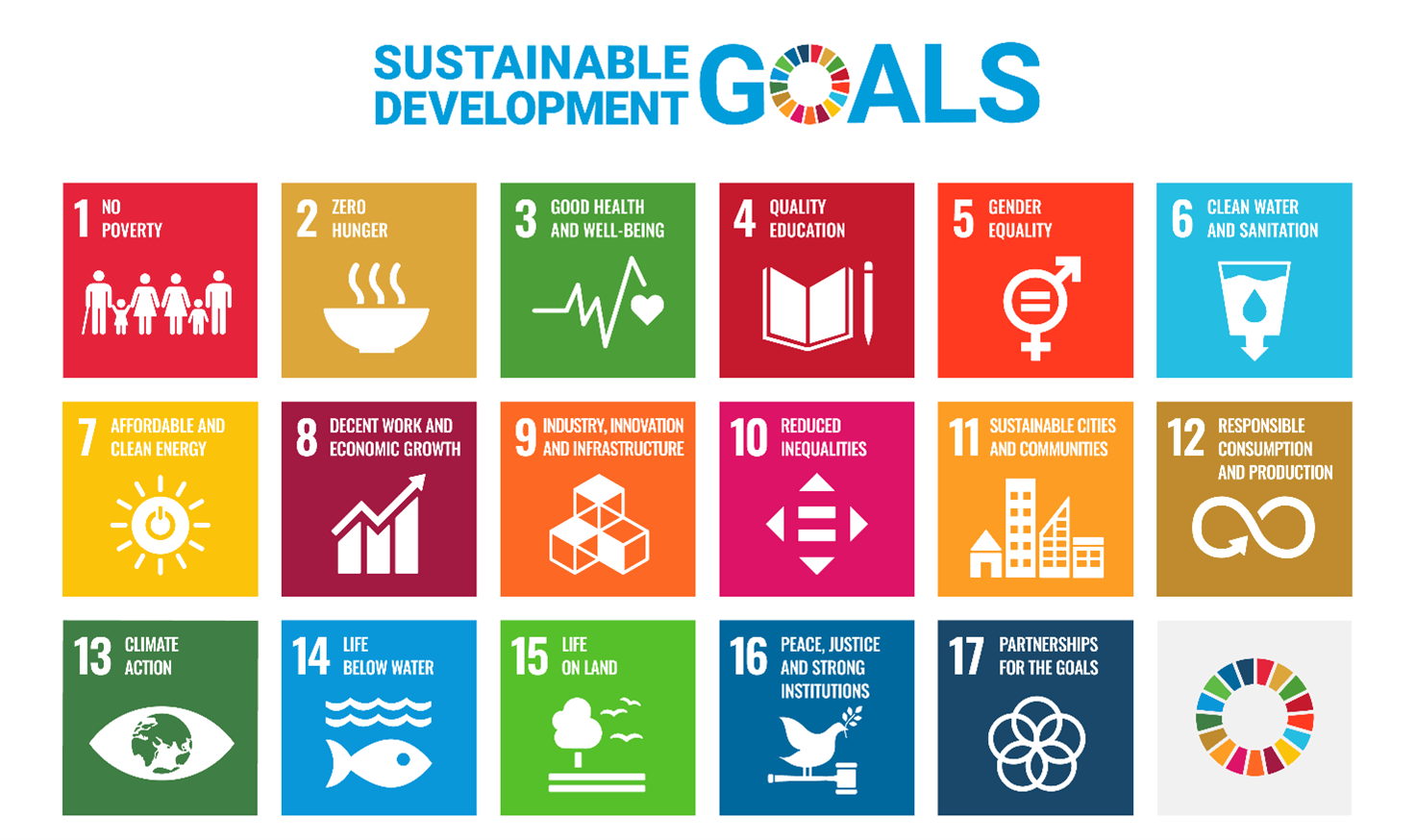
The 17 Sustainable Development Goals adopted by the United Nations in 2015 as part of the 2030 Agenda for Sustainable Development. Together, the goals address major global challenges related to poverty, inequality, environmental protection, economic development, and peace. The SDGs are interconnected and apply to all countries, emphasizing shared responsibility and the principle of leaving no one behind. Image from: https://www.un.org/sustainabledevelopment.
The world we live in is still very unequal. For many people, access to food, clean water, healthcare, and education is still uncertain, while others take these for granted. Gender inequality remains a problem, with women and girls in many countries earning less, having fewer opportunities, and facing higher risks of violence. Environmental inequality is also present. Communities that have contributed the least to climate change are often the ones most affected by it. At the same time, wealthier countries have more resources to adapt and recover. In the current state of the world, conflict and corruption make these problems even worse by limiting safety and rights.
This is why sustainable development matters. It is widely seen as a way to respond to these challenges in a long-term way. The United Nations Sustainable Development Goals (SDGs) describe a common goal for a fairer and more sustainable future. All 193 UN member states agreed to them in 2015 as part of the 2030 Agenda for Sustainable Development. SDGs guide global action to improve people’s lives, protect the planet, and support prosperity in the long run.
The agenda builds on the three traditional pillars of sustainability and expands them into what are known as the five Ps: people, planet, prosperity, peace, and partnership. People are placed at the center, with a clear aim to end poverty and hunger and to promote dignity and health. Protecting the planet is treated as essential, through responsible use of resources and urgent action on climate change. Prosperity is not defined only as economic growth, but as social and technological progress that respects environmental limits. Peace highlights the importance of equal and inclusive societies, while partnership stresses global cooperation and shared responsibility, especially for supporting the most vulnerable.
At the core of the SDGs are 17 interconnected goals that address a wide range of global challenges. These include reducing poverty, promoting gender equality, protecting the environment, addressing climate change, supporting sustainable economic growth, encouraging responsible consumption, strengthening governance, and promoting peace and justice. To make progress measurable and transparent, the goals are supported by 169 specific targets and 234 indicators.
The 2030 Agenda is guided by four key principles. Integration recognizes that global challenges are connected and cannot be solved in isolation. Universality means the agenda applies to all countries, regardless of income or development level, and acknowledges that every country still has work to do. Inclusiveness highlights that progress depends on the involvement of all parts of society, not only governments. The principle of leaving no one behind prioritizes those who are most vulnerable and at risk of being excluded from progress.
Although the SDGs have already helped improve millions of lives, progress is uneven and too slow. As of 2025, only around 35% of targets are on track or showing moderate progress, nearly half are proceeding too slowly, and about 18% are moving backward. With 2030 approaching, faster and more coordinated action is needed. The outcome matters directly for people, ecosystems, and vulnerable communities worldwide.
The content of this publication has not been approved by the United Nations and does not reflect the views of the United Nations or its officials or Member States.
References:
United Nations. (n.d.) The 17 goals. [www]. https://sdgs.un.org/goals
United Nations. (2025). The Sustainable Development Goals Report 2025 (PDF). https://unstats.un.org/sdgs/report/2025/The-Sustainable-Development-Goals-Report-2025.pdf
Sachs, J.D. (2015). Achieving the Sustainable Development Goals. Journal of International Business Ethics, 8(2), 53—62.
Sachs, J. D., Schmidt-Traub, G., Mazzucato, M., Messner, D., Nakicenovic, N., & Rockström, J. (2019). Six Transformations to achieve the Sustainable Development Goals. Nature Sustainability, 2(9), 805–814. https://doi.org/10.1038/s41893-019-0352-9
United Nations. (n.d). Transforming our world: the 2030 Agenda for Sustainable Development. [www]. https://sdgs.un.org/2030agenda
United Nations. (2019). Making global goals local business: Responsible business in the era of the Sustainable Development Goals. [PDF]. https://d306pr3pise04h.cloudfront.net/docs/publications%2FMGGLB+Brochure+2019.pdf
United Nations Development Programme. (n.d). Business and the SDGs. https://www.undp.org/sdg-accelerator/business-and-sdgs
Dugarova, E., & Gülasan, N. (2017). Global trends: Challenges and opportunities in the implementation of the Sustainable Development Goals. United Nations Development Programme (UNDP) & United Nations Research Institute for Social Development (UNRISD). [PDF]. https://www.truevaluemetrics.org/DBpdfs/UN/Global-Trends-UNDP-UNRISD-Report-2017.pdf
